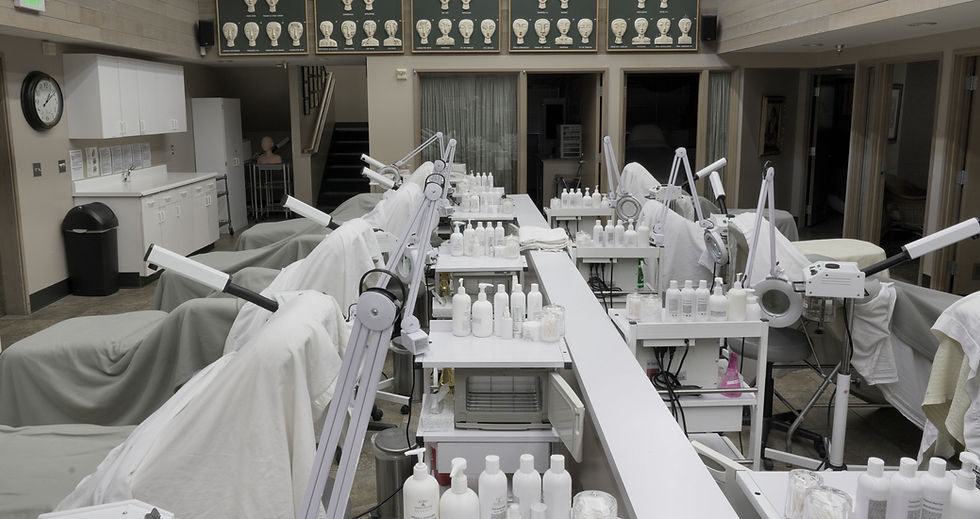
What Two Clinic Floors Taught Me That a Classroom Never Could


Ask most people what esthetics school looks like and they'll describe something familiar. Desks. Mannequin heads. An instructor demonstrating technique at the front of the room while students watch and take notes.
That's part of it, sure. But it's not the part that actually makes you good.
What makes you good is the part that happens when a real person is lying on your table, trusting you with their skin, and you have to know what to do — not because someone is walking you through it step by step, but because your training prepared you to figure it out.
That's what two clinic floors teach you. And you can't get it any other way.

The difference between knowing and doing
There's a gap between understanding a technique and executing it well on a real client. Every esthetics student discovers this gap at some point. The question is when — and whether you discover it in school, where you have support and supervision, or on the job, where the stakes are higher and the safety net is gone.
At The Euro Institute, students begin working with real clients early in their training. Not at the end, as a capstone. Not in a single supervised session before graduation. From early on, consistently, with actual people who booked actual appointments and are expecting actual results.
That changes everything about how you learn.

What real clients teach you
A mannequin head doesn't have combination skin that shifts with the seasons. It doesn't arrive stressed from a hard week, which means its skin is behaving differently than it did last month. It doesn't ask questions mid-treatment, or wince when a product isn't quite right, or tell you that the last place they went left their skin feeling tight for days.
Real clients do all of those things. And learning to navigate all of those things — calmly, professionally, skillfully — is what separates an esthetician who is technically trained from one who is genuinely prepared.
The clinic floors at The Euro are active. Clients come in consistently. Students build a real rhythm of client flow, treatment timing, room turnover, and professional communication — not in simulation, but in practice.
By the time a Euro student graduates, they've logged real hours with real people. That experience is visible from day one on the job. Employers notice it. Clients feel it.

The confidence you can't fake
There's a particular kind of confidence that only comes from having done something — really done it, not practiced it. From having handled a difficult skin condition and found your footing. From having a treatment go sideways and knowing how to recover gracefully. From finishing a session and seeing a client's face when they look in the mirror.
That confidence doesn't come from a classroom. It comes from the floor.
Students who train in active clinical environments graduate differently than those who don't. They walk into their first job with something that's hard to teach and impossible to shortcut — the quiet assurance of someone who has already been tested and knows they can handle it.
Why this matters more than you might think
The esthetics industry is competitive. Clients have options. Employers have standards. And the difference between a good esthetician and a great one often comes down not to what they know, but to how they perform under real conditions — with real people, real expectations, and no safety net.
The classroom gives you the foundation. The clinic floor gives you the career.
At The Euro Institute, you get both — and you get the clinic experience early enough that it shapes everything that follows.
We're enrolling our final two classes now - June and September 2026. If you've been considering training that actually prepares you — not just licenses you — we'd love to talk.